Timber-Clay Solid Slab: Timber Construction with Mass
The timber-clay solid slab makes optimal use of the advantages of two materials – timber and clay: the timber structure provides the load-bearing function, while the clay adds thermal mass to the room and ensures fire and sound protection.
While innovations in construction and production in recent decades have literally propelled timber construction to new heights, the field of floor and ceiling systems has long faced a range of unsatisfactory solutions.
On the one hand, multi-storey timber buildings must meet fire protection standards that, until recently, could only be achieved through resource-inefficient overdimensioning to account for charring or by incorporating concrete and gypsum. On the other hand, due to their low weight, timber slabs typically provide significantly lower sound insulation and thermal mass than solid slabs. Yet it is precisely thermal mass that could help buffer temperature fluctuations and keep buildings cool in summer without energy input.
This dilemma is reflected in the high degree of technical installations required in multi-storey timber construction, as well as in the limited spread of timber building in warmer climates, where mineral building materials perform more advantageously due to their mass. However, a construction method can only have a meaningful impact on climate change if it achieves at least some degree of global adoption. Conversely, the positive climate effect of timber construction can be undermined if the CO₂ savings in the construction phase are later offset—or, worse, multiplied—by higher operational energy demand.
Looking at material properties, clay proves to be the ideal complement to timber: in addition to being non-combustible, clay provides high (thermal) mass while generating very low CO₂ emissions during production. Its solubility in water allows it to be re-mixed and reused almost indefinitely without any loss of quality. For good reason, timber-clay hybrid constructions played a central role in traditional building practices and can still be found today in wattle-and-daub, wrapped, and infill slabs in half-timbered houses as well as in many 19th-century urban buildings.
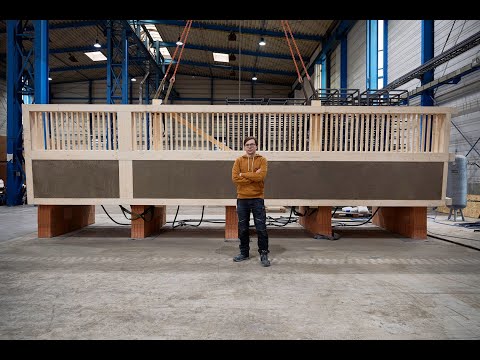
Born from a student project at the Faculty of Architecture of the TU Munich, the Timber-Clay Solid Slab can be understood as a contemporary translation of these historical techniques into the technical and economic realities of modern construction. Its structural framework is a self-supporting timber beam slab, designed and prefabricated according to the principles of modern timber construction. Clay with a bulk density of 2,100 kg/m³ is cast into the timber structure, adding fire resistance, sound insulation, and thermal mass.
The characteristic clay casting process is enabled by mineral additives that increase the material’s flowability without changing its water content. This allows the production of a clay infill with nearly the same density and strength as rammed earth—but at a fraction of the cost. The additives are toxicologically harmless, nearly negligible in terms of CO₂ footprint, and do not compromise the material’s ability to be re-liquified and reused.
After casting, the elements are air-dried for at least one week before being transported to the construction site and installed in the same way as conventional prefabricated timber elements. This approach adds no new complexity outside the factory and allows any timber or shell construction company to handle installation.
The first application of the Timber-Clay Solid Slab was realized in a remarkable administrative building for the Association for Rural Development in Tirschenreuth, located in the Upper Palatinate region. Inspired by late-19th-century architecture, Brückner & Brückner Architekten designed a timber–mass hybrid building in which concrete and steel are used only in the base slab. The building is composed of:
- 49 cm wood-fiber-filled bricks for exterior walls
- Unfired recycled “cold bricks” made from clay grinding dust for interior walls
- Timber-Clay Solid Slabs for intermediate floors and the roof, in the former case combined with ceramic screed tiles (Estrichziegel)
To optimize resource efficiency and recyclability, the component surfaces remain visible; only the façade is plastered, and interior walls are finished with a light whitewash. The combination of high (thermal) mass and carefully proportioned window openings eliminates the need for active cooling or shading devices, minimizing both energy consumption and maintenance requirements.
A total of 650 m² of floor and roof elements were manufactured for the project at Leipfinger-Bader’s facility in Pfeffenhausen. The components were individually adapted to meet geometric and technical requirements, delivered just in time, and assembled on-site by the shell construction contractor. Thanks to the dry assembly process, masonry work could continue immediately afterward, significantly accelerating the overall construction timeline.
At the heart of the Timber-Clay Solid Slab lies flexibility: depending on the project, the system can be configured in various ways. Lighting, thermal activation, or acoustic absorbers can be integrated into the slab elements, and the mineral underside can be factory-finished with clay plaster.
Since the clay infill is non-load-bearing, the system can already be flexibly implemented; only the fire protection rating still requires a burn-off dimensioning in current applications. In parallel, research is underway on vibration behavior, acoustic performance, and fire resistance—with a development goal of achieving a 90-minute fire resistance rating.
The overall objective is to create a slab system made entirely from timber and earth that meets all structural, acoustic, thermal, and fire protection requirements while remaining cost-effective and scalable. The aim is to establish an ecological building method that moves clay construction from niche to mainstream, making it viable and affordable for widespread use.